
%20(3).png)

The First Cycle: The Linear Laws That Govern Basketball

Updated: Mar 25

Basketball is not chaotic, random, or improvisational at its core—though it can look that way to the untrained eye. In truth, the game operates in cycles of linear learning. These cycles contain specific skills and knowledge of the laws of the game that promote efficiency, understanding, and competitiveness. They bring order to development and clarity to decision-making. When learned in sequence, they allow players to prosper on the court rather than merely survive possessions.
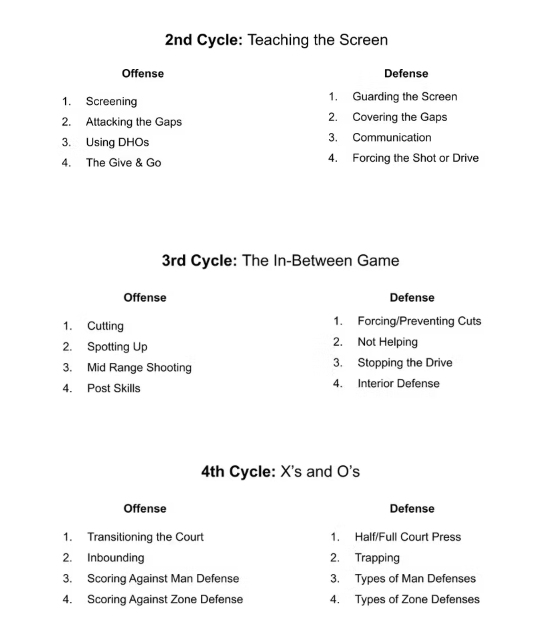
It is crucial that a player learns the 1st cycle as early as possible, and equally crucial that coaches reinforce it through their team offense and defense. Once the 1st cycle is mastered, a player naturally progresses into the 2nd, then the 3rd, and eventually the 4th (see "What's Next" section for more details on cycles 2-4). But everything rests on the foundation. Miss the first cycle, and the rest of the game becomes fragmented and inconsistent.
The 1st Cycle on Offense: Playing From the Shot
1. Correct Shooting Mechanics
This is the beginning of basketball. The game is played from the shot, not from isolation. Knowing how to shoot—and knowing how to begin the shot properly—defines offensive competency. On the catch, a player should engage their legs first and begin their shooting mechanics immediately, whether facing man or zone defense. The legs initiate everything. When this principle is honored, the game opens up.
2. Drawing Defenders
Proof that a player is truly playing from the shot is found in their ability to draw defenders. When a shooter commits to the shot by dropping their hips, the defender is placed in a dilemma: hesitate and surrender the shot, or close out and surrender the drive. They must pick their poison. This is why shooting must begin with the legs and not the arms. The body tells the truth before the ball ever leaves the hands.
3. Drawing and Kicking
Once a ballhandler commits downhill, help defense will arrive. At this point, the lesson is simple but profound: defer to someone else to finish the play. Forcing a contested finish undermines the advantage already created. Finding the open teammate is the mark of a player who understands the flow of the game.
4. Understanding the Closely Guarded Rule
This is where clarity becomes instinct. The closely guarded rule states that if a defender is within six feet of a ballhandler, a five-second count begins—whether the player is in triple threat, live dribble, or has ended their dribble. The count only resets if the ballhandler creates six feet of separation uphill or gets their head and shoulders past the defender downhill.
Once understood, this rule teaches evasive dribbling at the most fundamental level. Players realize they don’t need to be flashy or excessive. Simple, efficient movements reset the count and maintain advantage. I have personally seen players become highly competent ballhandlers overnight once this rule clicks—because now they understand the why behind their movements.
The Same Cycle—In Reverse—On Defense
Basketball is symmetrical. What governs offense also governs defense.
1. Reading the Shot
Since correct shooting mechanics are the first offensive lesson, the first defensive lesson is learning to read the shot. Can the defender recognize proper leg engagement? Is the shooter's arm properly formed? This allows the defender to judge the real threat level and respond intelligently instead of reacting blindly.
2. Closing Out
Closing out is the inverse of drawing a defender. A defender must be alert to the shot without overcommitting, understanding that a shooter’s legs can deceive them. Discipline, balance, and recovery define a great closeout—not recklessness.
3. Helping on Defense
Defense reaches its highest expression when teammates are connected. Once a primary defender is beaten, coordinated help and secondary perimeter rotation must follow. Forcing a penetrating ballhandler to pass is the objective. This collective response is the hallmark of elite defenses.
4. Legal Guarding Position
Understanding the closely guarded rule empowers defenders to be proactive. By learning legal guarding position—defined clearly in the rule book—defenders can apply pressure without fouling and even hunt closely guarded violations. When defenders know the legal movements they are allowed, defense becomes aggressive, intentional, and fun.
Why Linearity Matters
I stress linearity and these cycles of learning because they are true to the fundamentals of the game, lead to highly effective play, and align with the natural circadian rhythm of basketball. This order can be observed at every level of the sport, including the highest levels of competition. Mastery is not accidental—it follows structure.
"Mandatory Basics" Within the 1st Cycle
While mastering the first cycle, players must also understand several non-negotiable fundamentals:
Ballhandling:
Ball-body-defender protection, basic left- and right-hand dribbling*, and the retreat dribble*. Triple-threat maneuvers are essential—specifically the rip-through and swing-through. The rip leads to the pivot; the swing leads to the jab. These are taught first because of court angles and the closely guarded rule.
Rebounding:
Boxing out and crashing the glass. Possession still matters.
Passing:
The three fundamental passes, faking before making a pass, and understanding that if a fundamental pass cannot be made, then no one is truly open.
Finishing:
Basic left- and right-hand finishes*, and when appropriate, a jump stop to score off two feet with strength and balance.
*non-imperative
Simplicity Is the Gift
I wrote this to help my players see the game—clearly and peacefully. To understand that basketball is simpler than it is often presented, and that they are already far more capable than they believe. An entire season can—and should—be devoted to the 1st cycle of learning. When mastered, it encompasses much, if not all, of the nature of organized basketball.
A player who understands this cycle should read these words with joy and with peace, knowing that if they are applying these skills—individually and collectively—they are already operating at an elite level.
Shalom.
What's Next?
After completing the first cycle, here is what you can look forward to in your development from cycles 2-4:


Comments